Aerial Concrete & Material Placement in Queensland
Where the pump truck cannot reach and the boom cannot see, concrete goes in by kibble, cycle after cycle at about 3 minutes each, on time and on grade.
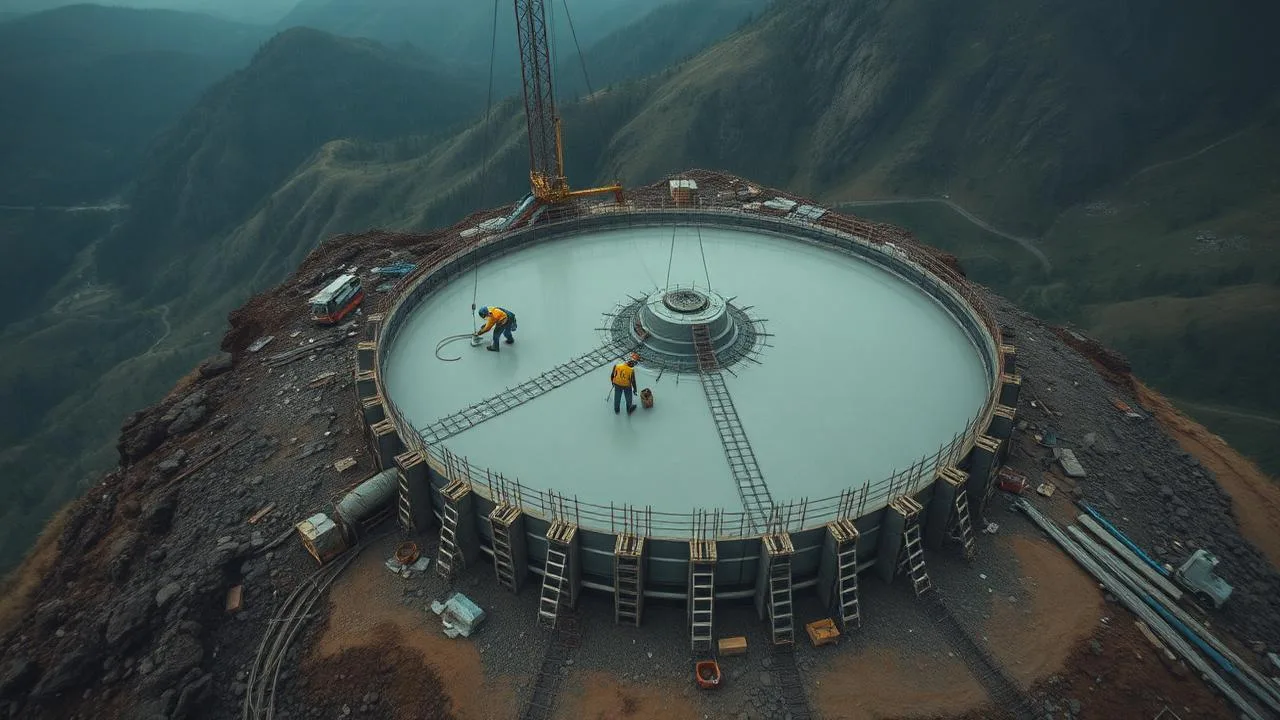
The problem
Why this lift is hard the conventional way
Concrete is unforgiving: it has to arrive continuously, in sequence, and it will not wait for a track to be built.
- Pump lines have finite reach and cannot cross gullies or water.
- Agitators cannot access ridgelines, islands or unformed ground.
- Building a temporary track for one pour rarely stacks up.
- Interrupted pours create cold joints and rework.
How we do it
Aircraft, rigging, crew and duration
- Aircraft
- AS350, working maximum 800 kg, used for continuous kibble cycles
- Rigging method
- Certified concrete kibble with remote release, long line
- Crew
- Pilot, loadmaster, batching-side pair, placement crew at the pour
- Typical duration
- Continuous cycles of about 3 minutes each; typically 6 to 9 m³ per hour
- Pour plan sequenced against batch plant supply and cycle time.
- Batching and hook-up point established as close as practical to the pour.
- Kibble cycles flown continuously with a second kibble filling on the ground.
- Placement crew screed and finish as each load is released.
Typical loads
What we lift, what it weighs, what it takes
| Item | Weight range | Aircraft | Typical time |
|---|---|---|---|
| Concrete kibble (0.3 m³) | ≈720 kg | AS350 | 3 min/cycle |
| Concrete kibble (0.25 m³) | ≈600 kg | AS350 | 3 min/cycle |
| Reinforcement bundle | 300–700 kg | AS350 | 5 min |
| Formwork package | 250–650 kg | AS350 | 5 min |
| Aggregate or sand bag | 400–780 kg | AS350 | 4 min/cycle |
Indicative only. Working payload reduces with radius, temperature and density altitude; every load is confirmed against the day's conditions.
Get your price range in a minute
Tell us the load and the site. You see an indicative range before we ask for your details. From $14,000 plus GST.
Request a liftRelated work
Lifts we have flown
720 kg
Ridgeline tower footings
Eighteen cubic metres placed in a continuous morning pour with two kibbles in rotation, cycles under 4 minutes.
Sunshine Coast · AS350
600 kg
Island jetty abutment
Batch plant on the mainland, pour on the island, no barge involved.
Moreton Bay & Islands · AS350
720 kg
Escarpment retaining works
Pump line reach exceeded by 90 m; kibble cycles closed the gap in around 3 minutes per load.
Toowoomba & Darling Downs · AS350
Site requirements
What you need ready on the day
- Batch plant supply confirmed to match the flying cycle rate.
- Hook-up and filling point clear, level and marshalled.
- Placement crew briefed on kibble release and downwash.
- Pour sequence and cold joint plan agreed before the window.
- Water and clean-down provisions at the filling point.
Cost factors
What moves the number
Cubic metres
Total volume sets the number of cycles and therefore the flight hours.
Cycle distance
Every hundred metres between batch point and pour adds cycle time.
Supply continuity
The aircraft is idle whenever the batch plant is behind; sequencing is everything.
Site remoteness
Mobilisation to non-metropolitan pours is billed separately.
Questions
Concrete & material placement, frequently asked
Coverage
Where we fly this work
We provide concrete & material placement across Brisbane, Gold Coast, Sunshine Coast, Toowoomba & Darling Downs, Wide Bay, Rockhampton & Capricorn Coast, Mackay & Whitsundays, Townsville, Cairns & Far North Queensland, Mount Isa & North West Queensland, Moreton Bay & Islands and everywhere else in Queensland, mobilising from 18 min in Brisbane to 5.8 hours in the North West.
Related services
Ready to book a lift?
Get an indicative price in about a minute, then a written quote.